For solo founders and small product teams
You ran 17 experiments this year. Where are 12 of them now?
One place for the hypothesis,
the result, and the insight.
Write a hypothesis. Pick any validation method, including the built-in cookie-free A/B test. Capture the insight. Every future hypothesis inherits everything you already proved.
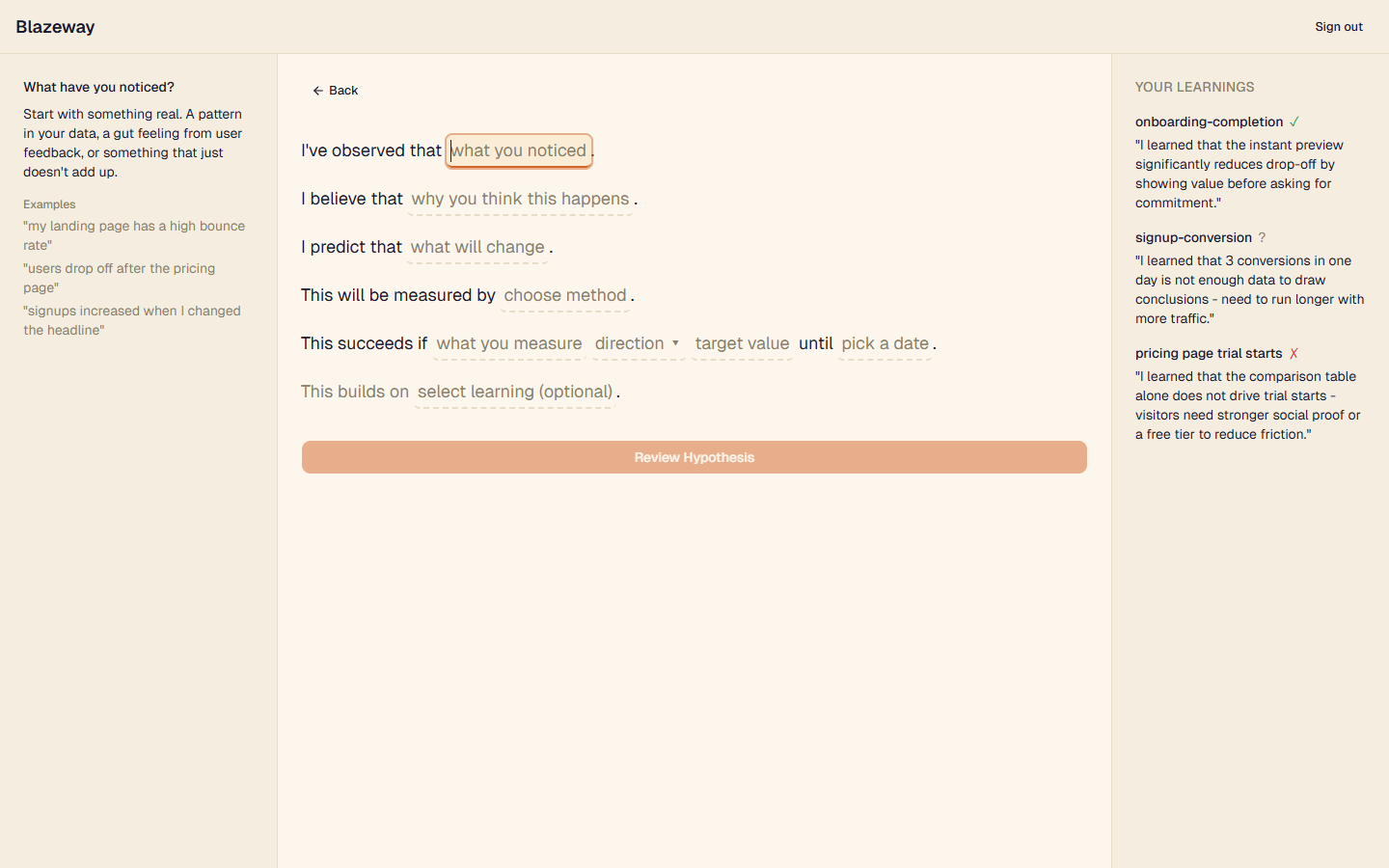
I've observed that.
Privacy-first by design. No cookies, no fingerprinting, no consent banner.
How Blazeway works
Four steps. One experiment journal.
Write what you believe
Every experiment starts with a sentence. "I've observed X. I believe Y. I predict Z." Not a ticket, not a Jira card. A thought you can revisit six months later and still understand why you ran the test. The structured sentence forces clarity before you ship.
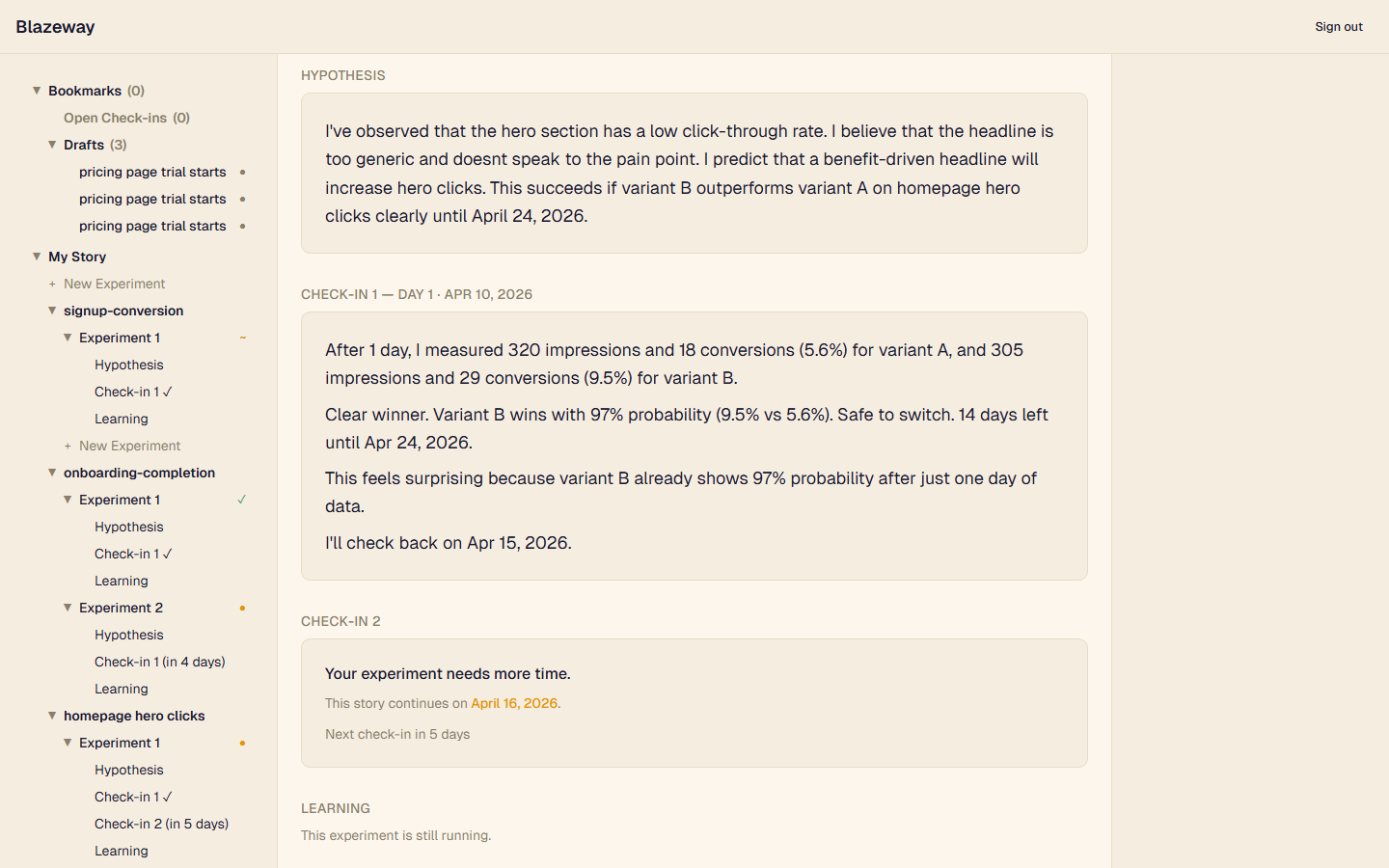
Check in. Reflect. Decide.
Your test is running. Data comes in. Before you call a winner, you check in: What does the data say? How confident am I? Does this surprise me? Each check-in becomes a chapter in your experiment's story. Bayesian probability tells you when you have enough signal.
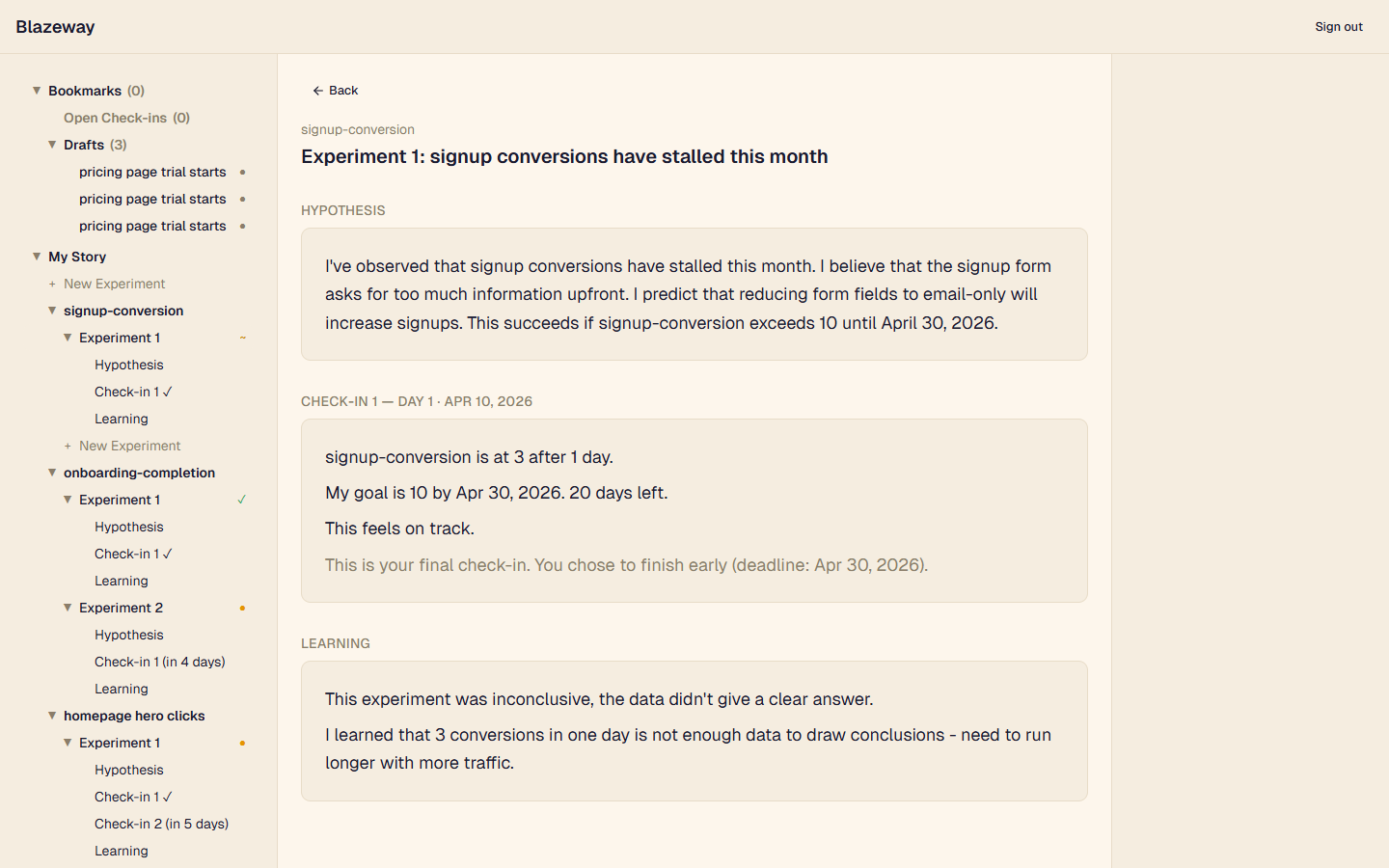
Capture what you learned
B won by 14%. Great. But that number fades. What stays is why it worked. You write down the mechanism, the surprise, the thing you'd tell a colleague. That one sentence compounds. You'll still use it when you plan your next quarter.
"The learning outlasts the data."
See patterns you missed
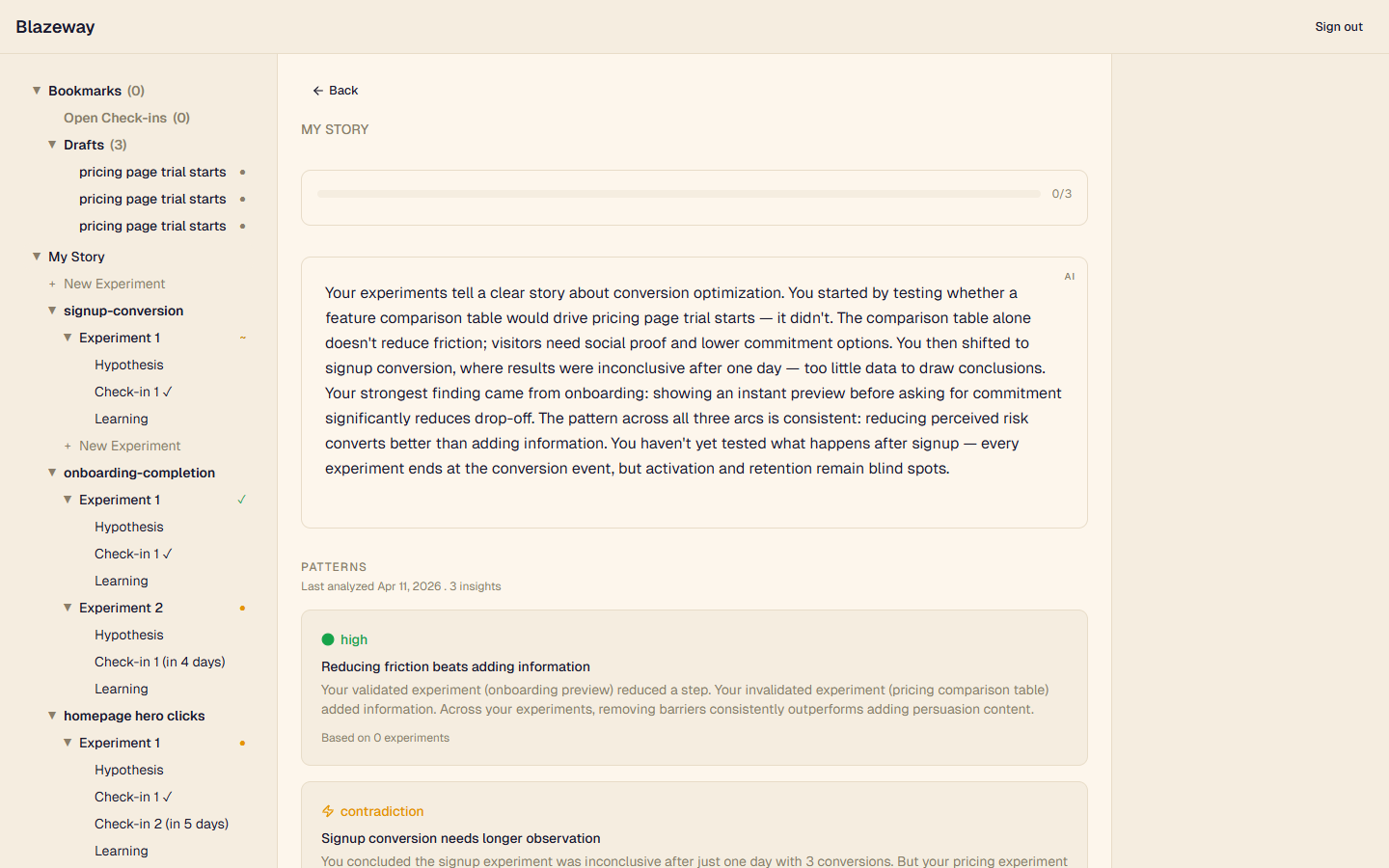
After 5 experiments, your journal tells a story. Export it to an AI. It finds cross-test patterns, contradictions, and where to place your next bet. Not a dashboard. A narrative of how your product thinking evolved.
Built for how you work
The details that make it practical.
Your hypothesis is a thinking tool.
Most tools ask for a test name and two variants. Blazeway asks you to think. "I've observed... I believe... I predict... This succeeds if..." The structured sentence separates real hypotheses from gut feelings. Run manual experiments without any tracking code, or wire up automatic tests. Four methods, one journal.
Manual A/B: assign variants yourself, track by hand
Automatic Event: one script tag, we count conversions
Automatic A/B: we split traffic, you watch the story unfold
Story arcs. Connections. Context.
Group experiments into arcs like "Pricing" or "Onboarding." Draw connections between related tests. When you revisit a decision in three months, you see the full trail, not scattered notes.
Cookieless. No banner needed.
SHA-256 daily hash. No cookies, no localStorage, no fingerprinting. Every visitor counts. GDPR-compliant by architecture, not by banner.
With Blazeway
After 20 experiments, you know exactly which mechanisms move your audience. You open your decision history, spot the pattern, and place your next bet with conviction. Every test made the next one sharper.
Without it
After 20 experiments, you have 20 data points. Each one lived in its own spreadsheet row. You run another test. Same gut feel as the first one. The experiments compound. The knowledge doesn't.
Pricing
Simple. Honest.
Start free. Upgrade when you need more volume. No credit card required.
Free
Perfect for small projects and focused experiment sprints.
- Unlimited experiments
- Experiment journal with story arcs
- Structured learning capture
- Check-ins with sentiment tracking
- Cookieless GDPR tracking
- 1,000 events / month
Starter
When your experiments grow, your event volume does too.
- Everything in Free
- 2,000 events / month
Start free. Upgrade when you need more volume. No credit card required.
FAQ
Common questions.
Is Blazeway available right now? +
Yes. Sign up for free at app.blazeway.app and run your first experiment in about five minutes.
What do you mean by 'experiment journal'? +
Every experiment has a story: a hypothesis, check-ins as data arrives, and a learning when it's done. Blazeway organizes these into arcs and connections so your past decisions inform your next ones.
How is Blazeway different from GrowthBook or PostHog? +
They're built for data teams running hundreds of experiments. Blazeway is an experiment journal for one person. You document what you believe, check in as data arrives, and capture what you learned. We optimize for the decision trail, not statistical depth.
Can I run experiments without tracking code? +
Yes. Manual experiments let you document any decision, test, or observation without installing anything. When you want automatic tracking, add one script tag.
What are story arcs? +
Arcs group related experiments. Your 'Pricing' arc might have five experiments across six months. When you revisit pricing, you see the full trail in one place.
Do I need a cookie banner? +
No. Blazeway runs without cookies, localStorage, or fingerprinting. GDPR-compliant by architecture, not by banner.
How long does setup take? +
About five minutes. Add the script tag, define variants, set a conversion goal, go live.
Do I need a data team? +
No. Results are in plain language. Which variant won, by how much. No p-values to explain.
Your product is trying to tell you something. Start listening.
Start documenting what you believe. Five minutes to your first experiment.
Start your first experiment →Free plan available. No credit card.
Built by Daniel Janisch in public. Read why →